Introduction
As commercial lighting projects become increasingly specialized, buyers are looking for more than standard products.
Distributors, contractors and lighting brands often require customized solutions that align with project specifications, branding requirements and market positioning.
This is where OEM and ODM manufacturing become important.
Understanding the differences between OEM and ODM can help buyers reduce risks, improve project flexibility and choose the right manufacturing partner.
What Is OEM Lighting Manufacturing?
OEM stands for Original Equipment Manufacturer.
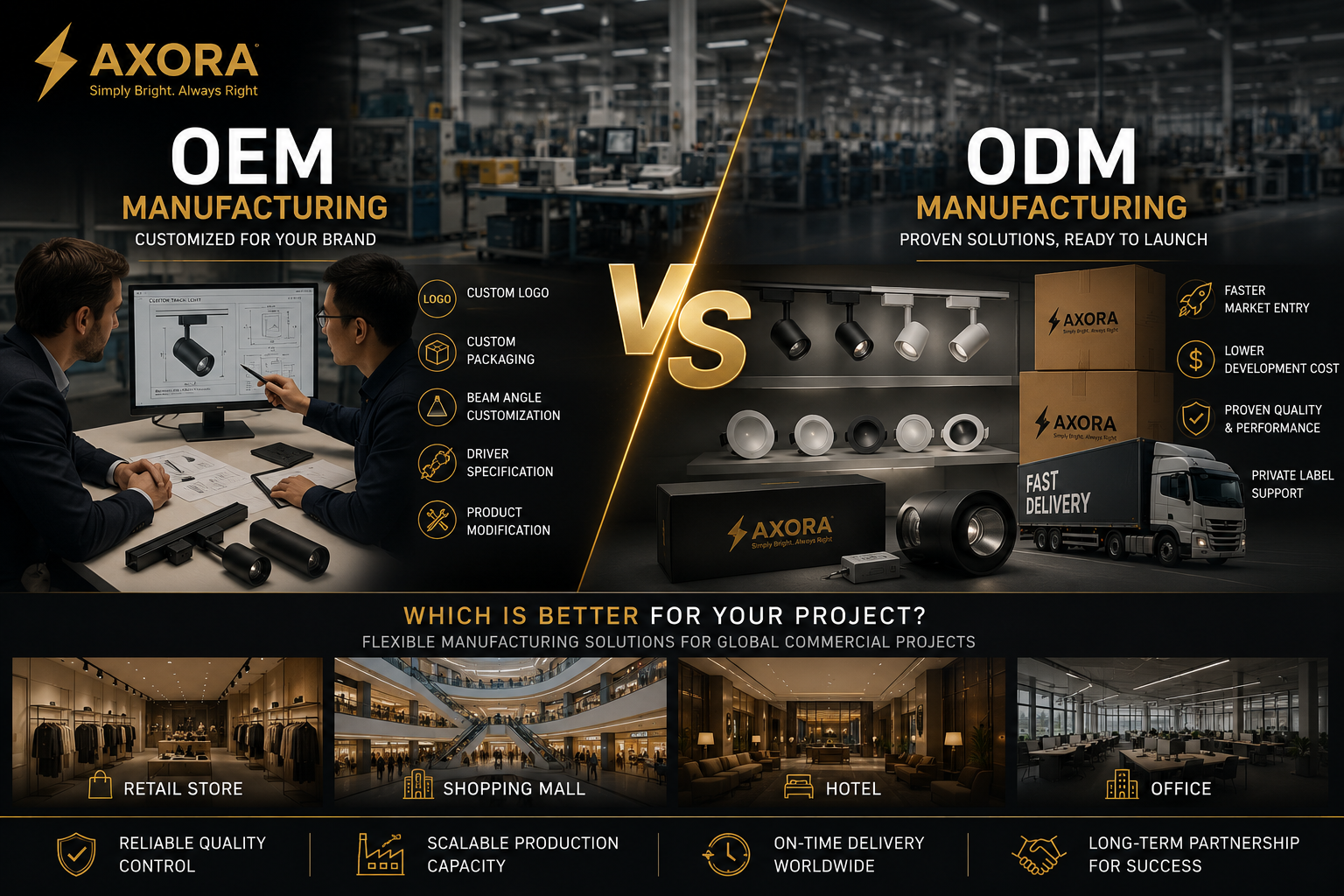
In an OEM model, the customer provides specifications, branding or design requirements, while the manufacturer produces the product accordingly.
Typical OEM customization includes:
- Logo printing
- Custom packaging
- Beam angle customization
- Special finishes
- Driver specifications
- Product modifications
OEM is often preferred by:
- Lighting distributors
- Established brands
- Regional wholesalers
- Project contractors
What Is ODM Lighting Manufacturing?
ODM stands for Original Design Manufacturer.
In this model, the manufacturer develops the product and the customer applies their own branding.
Advantages include:
- Faster market entry
- Lower development costs
- Proven product performance
- Reduced engineering effort
ODM is often suitable for:
- New lighting brands
- Small distributors
- Emerging markets
- Fast-moving projects

OEM vs ODM: Key Differences
| Factor | OEM | ODM |
|---|---|---|
| Product Design | Customer Driven | Manufacturer Driven |
| Development Cost | Higher | Lower |
| Customization | High | Limited |
| Lead Time | Longer | Faster |
| Brand Differentiation | Strong | Moderate |
| Initial Investment | Higher | Lower |
When OEM Is the Better Choice
OEM is ideal when:
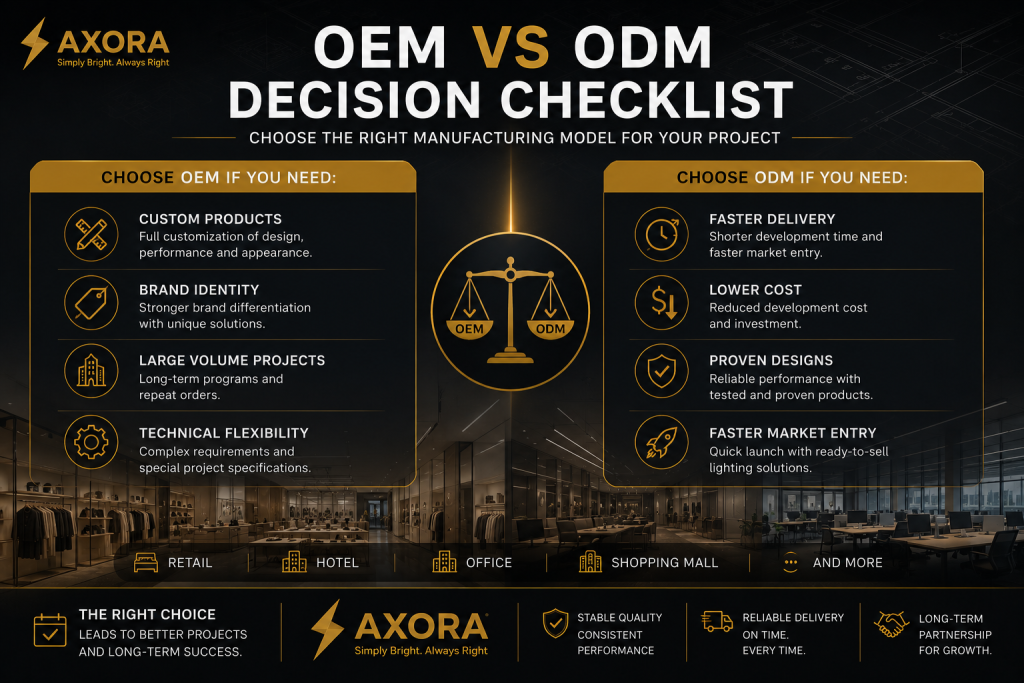
Brand Identity Matters
The buyer wants unique products.
Large Volume Projects
Long-term programs justify customization.
Technical Requirements Are Complex
Special optics or project specifications are required.
Market Differentiation Is Important
Competing through unique product offerings.
When ODM Is the Better Choice
ODM is ideal when:
Speed Is Critical
Products can be launched faster.
Budget Is Limited
Lower development investment.
Proven Designs Are Preferred
Reduced technical risk.
Small Teams Need Efficiency
Less engineering involvement.
Common Mistakes Buyers Make
Choosing OEM Too Early
Customization may increase costs unnecessarily.
Choosing ODM for Highly Specialized Projects
Some projects require more flexibility.
Ignoring Future Expansion
Consider long-term product availability.
Focusing Only on Unit Price
Project success depends on total value, not only cost.
How Commercial Lighting Projects Typically Decide
For:
Retail Chains
Often use OEM.
Hotel Groups
Often combine OEM and ODM.
Office Projects
Frequently use ODM with minor customization.
Shopping Mall Developments
Often use OEM for consistency across phases.

What Professional Buyers Should Evaluate
Before selecting an OEM or ODM supplier, evaluate:
✔ Manufacturing capability
✔ Technical support
✔ Supply stability
✔ Commercial project experience
✔ Long-term cooperation potential
How AXORA Supports OEM and ODM Projects
AXORA supports both OEM and ODM commercial lighting programs, providing scalable manufacturing, optical consistency, project-oriented solutions and long-term cooperation for retail, hospitality, office and commercial developments. AXORA focuses on reliable supply capability and project execution rather than one-time transactions.
Our capabilities include:
- Private label support
- Custom packaging
- Beam angle customization
- Project-specific solutions
- Batch production management
- Long-term repeat supply
Conclusion
Neither OEM nor ODM is universally better.
The right choice depends on:
- Project objectives
- Budget
- Timeframe
- Branding requirements
- Long-term strategy
Understanding these differences helps buyers make more informed decisions and build stronger partnerships with lighting manufacturers.
CTA
Looking for an OEM or ODM Lighting Partner?
AXORA supports:
✔ Retail Projects
✔ Commercial Developments
✔ Private Label Programs